
How Towing Companies Can Rank number 1 on Google Maps and Grow with Roadside Towing Marketing

When a driver is stuck on the shoulder, they do not scroll for long. They open Google Maps, search “tow truck near me” or “roadside assistance”, and call one of the first companies they see.
That is why Google Maps visibility matters so much for towing companies. A higher Maps position can mean more emergency calls, more winch-outs, more jump starts, and more steady work without relying only on dispatch networks or word of mouth.
The hard truth is this: no agency can honestly guarantee the number one spot in every search, every day. Google Maps rankings change based on location, search terms, competition, proximity, reviews, and business activity. But a towing company can build the signals Google looks for and give itself a far better chance of showing up at the top.
This guide breaks down what actually helps towing companies rank higher on Google Maps and how Roadside & Towing Marketing can support that growth with a focused, industry-specific approach.

How Towing Companies Can Rank number 1 on Google Maps
Why Google Maps ranking is different for towing companies
Towing is not like many other local services. A homeowner might compare roofers for two weeks. A driver with a flat tyre needs help now.
That urgency changes the way people choose a towing company. They usually look for:
A nearby company
A strong star rating
Recent reviews
Clear service hours
Fast phone access
Services that match the problem
Trust signals that feel real
Google Maps tries to show businesses that are relevant, close enough, and credible. For towing companies, that means your online presence has to answer one simple question:
Can this company help the driver quickly and safely?
Your Google Business Profile, website, reviews, service pages, photos, citations, and local content all help answer that question. When those pieces are weak or inconsistent, Google has less reason to place your towing company above competitors.
When they work together, your company becomes easier to find, easier to trust, and easier to call.
Start with a complete Google Business Profile
Your Google Business Profile is the foundation of Google Maps ranking. If it is incomplete, messy, or outdated, every other tactic becomes harder.
A strong profile should include the correct business name, phone number, service areas, opening hours, categories, services, business description, photos, and website link.
Choose the right primary category
The primary category tells Google what your business mainly does. For most towing companies, the best fit is usually a towing-related category rather than a broad automotive category.
Secondary categories can support other services such as roadside assistance, tyre change, battery jump start, lockout service, or transport services if they apply to the business.
Do not add categories just because competitors use them. Use categories that match real services you provide.
Keep the business name clean
A common mistake is stuffing keywords into the business name. For example, a company may try to rename its profile with extra city names and service terms.
That may look tempting, but it can lead to profile edits, suspensions, or trust problems. Use the real-world business name. Build relevance through categories, services, content, reviews, and your website instead.
Fill out every service field
Towing companies often provide many services, but only list “towing” on the profile. That leaves traffic on the table.
Add clear service entries where available, such as:
Light-duty towing
Medium-duty towing
Flatbed towing
Motorcycle towing
Accident recovery
Winch-out service
Jump starts
Fuel delivery
Lockout help
Tyre changes
Long-distance towing
The wording should match how customers search, while still staying accurate. If you do not offer heavy-duty towing, do not list it. Wrong-fit calls waste time and can hurt customer experience.
Build a website that supports Maps rankings
A Google Business Profile can rank on its own, but a useful website strengthens it. Google looks at your website to better understand the business, the areas served, and the services offered.
For towing companies, the website should not be complicated. It should be fast, clear, mobile-friendly, and built around calls.
Make the phone call obvious
Most towing leads come from mobile searches. If the website makes people hunt for the phone number, calls will drop.
Every important page should include:
A tap-to-call phone number
Service area information
Main towing and roadside services
Emergency availability details
Clear next steps for a stranded driver
The contact experience should be simple. A driver in stress does not want to read a long company story before calling.
Create service pages for real searches
A single homepage is rarely enough. If a company offers several services, each major service deserves its own page.
Examples include:
Towing service
Roadside assistance
Flatbed towing
Motorcycle towing
Accident towing
Jump start service
Car lockout service
Fuel delivery
Winch-out service
Each page should explain what the service includes, when someone needs it, what areas are covered, and how to request help.
This helps Google connect your business to many different towing and roadside searches, not just one broad term.
Create location pages with care
If your company serves multiple cities or suburbs, location pages can help. But they need to be useful, not thin copies with city names swapped in.
A good location page should include:
The actual area served
Common towing needs in that area
Nearby roads, motorways, neighbourhoods, or landmarks where relevant
Services available in that location
Simple call instructions
Avoid creating dozens of nearly identical pages. Quality beats volume.
Reviews can make or break Maps performance
Reviews affect both ranking and conversion. A towing company with many recent, detailed reviews has a clear advantage over a company with few reviews or a weak rating.
Drivers want proof before calling. They look for comments about speed, price honesty, safety, and professionalism.
Ask at the right moment
The best time to ask for a review is soon after a successful job, when the customer is relieved and the experience is fresh.
A simple request works well:
“Glad we could help today. If you have a minute, a Google review helps local drivers find us when they need towing.”
Keep the process easy. Send a direct review link by text when appropriate.
Reply to every review
Review replies show customers and Google that the business is active. Replies do not need to be long.
For positive reviews, thank the customer and mention the service naturally.
For negative reviews, stay calm. Do not argue. A professional reply can protect trust even when the review is not ideal.
A good negative review response should:
Acknowledge the concern
Avoid sharing private details
Invite the customer to contact the business
Stay respectful
Do not buy fake reviews
Fake reviews are risky and often obvious. They can get filtered, damage trust, or cause profile problems. Towing is a trust-based service. Real customer feedback is far more valuable.

Keep business details consistent everywhere
Google wants confidence that your business is real and active. Consistent business information across the web helps build that confidence.
Your name, address, phone number, website, and hours should match across key profiles and directories. These are often called citations.
For towing companies, useful listings may include general business directories, local directories, automotive directories, roadside service listings, and industry-related platforms.
The most common problems are:
Old phone numbers
Different business names
Wrong opening hours
Outdated addresses
Duplicate listings
Service areas that do not match
A citation clean-up may not feel exciting, but it often fixes hidden trust issues that hold back Maps performance.
Add photos that prove the business is active
Photos help your listing feel real. They also show Google and potential customers that the company is operating.
Good towing photos include:
Tow trucks in service
Clean equipment
Flatbed loading
Roadside assistance jobs
Night-time towing where safe to capture
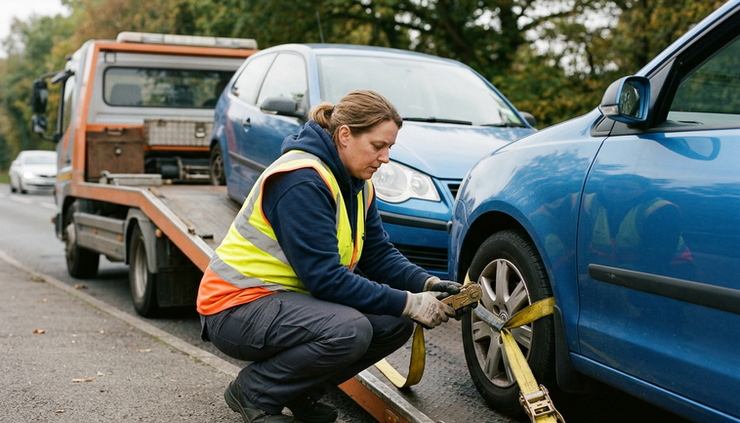
Team members at work in appropriate clothing
Before-and-after recovery moments, without private or sensitive details
Avoid using only stock photos. They look generic and do not build the same trust.
Photos should be added regularly, not once and forgotten. A towing company that posts fresh service photos looks more active than one with a profile that has not changed in years.
Use local content to reinforce service areas
Local content helps connect your towing business with real places and real customer problems.
This does not mean writing empty blog posts just to mention city names. It means creating helpful content that answers common roadside questions.
Examples include:
What to do after a breakdown on a busy road
When to call a flatbed tow truck
How to prepare for long-distance towing
What drivers should do after a minor accident
Signs your car needs towing instead of driving
What information to share when calling a tow truck
Content like this can support organic search and give your Google Business Profile a stronger website to point to.
A strong content plan also builds topical authority. Google can better understand that your business is not only located in a service area, but also deeply connected to towing and roadside help.
Track the numbers that actually matter
Ranking number one looks great, but rankings alone do not pay the bills. Calls do.
A towing company should track the signals tied to real growth:
Calls from Google Business Profile
Website calls
Direction requests where relevant
Form fills
Search terms reported in the profile
Review count and rating
Profile views
Service page traffic
Missed calls
Booked jobs from online sources
Missed calls deserve special attention. If marketing brings in more phone calls but nobody answers, growth stalls. A strong Maps strategy should be paired with fast phone response and clear dispatch handling.
Why towing companies need a specialised marketing approach
Many marketing agencies work with every type of local business. Towing is different.
A towing campaign has to account for urgency, service areas, mobile search behaviour, after-hours calls, review pressure, and high competition in Maps results. The plan must turn online visibility into phone calls, not just website visits.
That is where an industry-focused partner can help.
Roadside & Towing Marketing focuses on marketing for towing and roadside assistance businesses. That kind of focus matters because the strategy needs to match how drivers search when they are stranded.
A proper campaign may include:
Google Business Profile improvements
Local Maps ranking work
Towing website improvements
Service page creation
Review growth systems
Citation clean-up
Call-focused conversion changes
Local content planning
Tracking and reporting
The goal is not just to look better online. The goal is to get more qualified towing and roadside calls from people who need help now.

Common mistakes that stop towing companies from reaching the top
Many towing companies work hard offline but lose visibility online because of fixable mistakes.
The profile is incomplete
A half-filled Google Business Profile sends weak signals. Missing services, poor photos, outdated hours, and thin descriptions all reduce trust.
The website is slow or confusing
If the site loads slowly on mobile or hides the phone number, callers leave. A towing site must be built for speed and action.
Reviews come in randomly
A company that only gets reviews by chance will usually fall behind competitors with a steady review process.
Service areas are too broad
Trying to rank everywhere often weakens the focus. It is better to build strength in real service areas first, then expand.
Content does not match customer intent
A driver searching for emergency towing needs help, not a vague article about vehicle care. Pages should match urgent search intent.
Tracking is missing
Without tracking, a company may not know which calls came from Maps, which pages perform well, or where leads are being lost.
What a realistic path to number one looks like
Ranking number one on Google Maps is not a one-time task. It is a process.
A realistic path looks like this:
Fix the Google Business Profile
Make the profile complete, accurate, and service-focused.
Improve the website
Build clear pages for towing, roadside assistance, and key service areas.
Clean up citations
Make business details consistent across trusted listings.
Build reviews steadily
Ask real customers, reply professionally, and keep the profile active.
Add fresh photos
Show real trucks, real equipment, and real roadside work.
Publish useful local content
Answer common customer questions and support service area relevance.
Track calls and rankings
Measure what leads to booked towing jobs.
Keep improving
Competitors change, search behaviour changes, and the profile needs ongoing care.
That steady work is how towing companies build stronger Maps positions and more call volume.
Work with a towing marketing team that understands the road
If your towing company wants more calls from Google Maps, random marketing is not enough. The work needs to be specific to towing, roadside assistance, and local emergency search.
For help building a stronger Maps presence, improving your towing website, and turning searches into calls, visit Roadside & Towing Marketing.
The takeaway
The companies that win on Google Maps usually do the basics better and longer than everyone else. They keep their profiles accurate. They earn real reviews. They build useful service pages. They show proof through photos. They track calls. They keep improving even after rankings rise.
That is how towing companies can rank higher, compete for the top spots, and turn Google Maps visibility into steady roadside and towing jobs.


Comments